
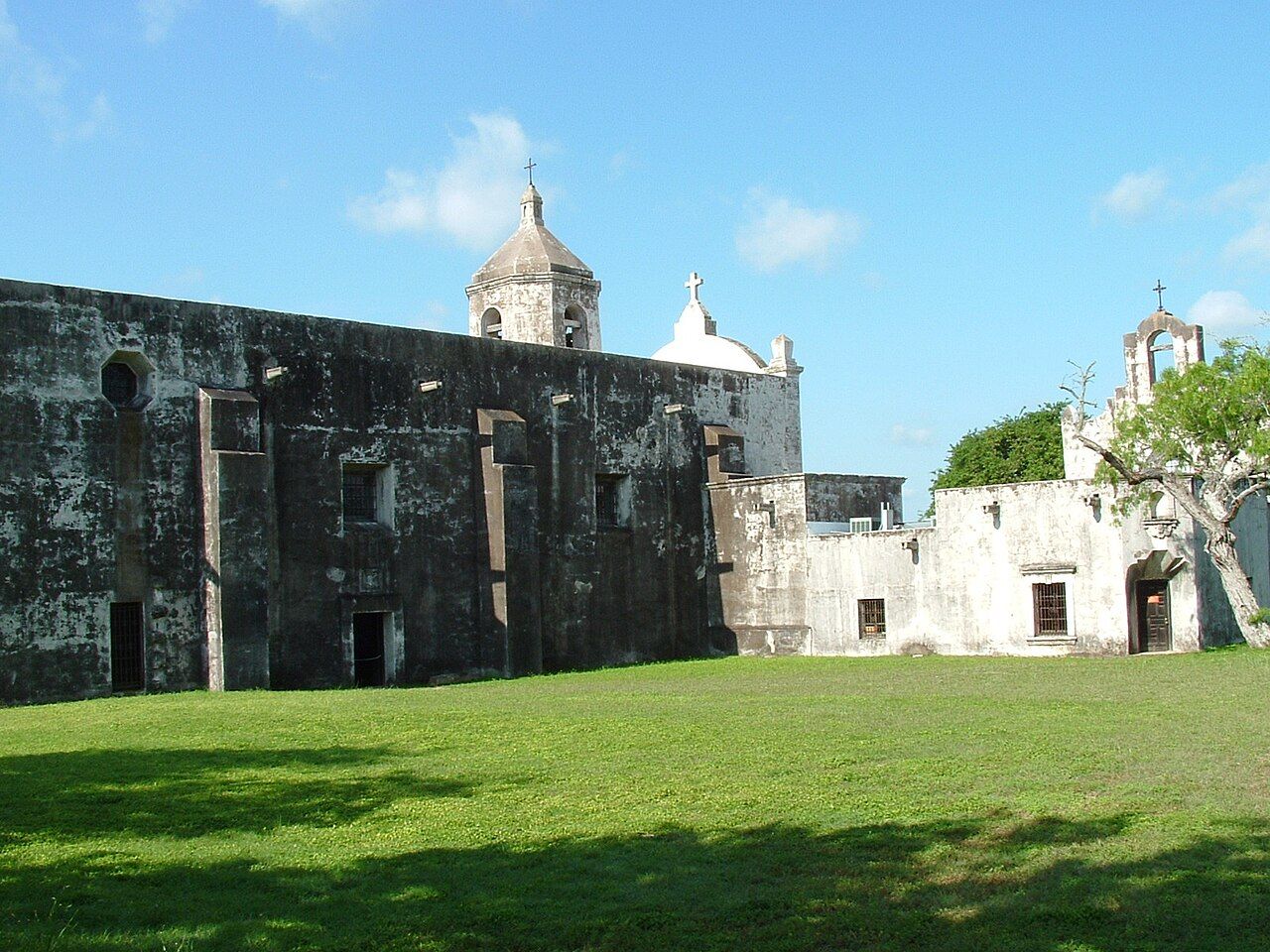
Goliad lies on the San Antonio River about an hour and a quarter inland from Rockport, through ranch country of mesquite, live oak and wide fields. It is a quiet county seat with a courthouse square and a handful of streets, but it carries more history than towns many times its size. Two Spanish foundations stand on either side of the river just south of town: Presidio La Bahía, a stone fort, and Mission Espíritu Santo, a church and mission compound. Both were part of Spain's effort to hold this edge of its empire in the eighteenth century, and both were drawn into the events of 1836 that gave Goliad its place in Texas memory.
A visit here is a change of pace from the coast. There is no beach and little shade, but there is a great deal to think about.
Two Spanish foundations on the river
The Spanish first established a presidio and mission on the coast near Matagorda Bay, and moved them inland more than once before settling at this spot on the San Antonio River around the middle of the eighteenth century. The presidio, known by its old name of La Bahía, "the bay", guarded the road between the coast and the settlements of the interior. The mission, set across the river, was meant to gather and convert the local Indigenous peoples and became a large ranching operation, with herds of cattle grazing the prairies around it.
The two are best understood together. The fort protected the mission; the mission fed the fort. Under Spain and then Mexico, the settlement around them was a garrison town and a crossroads, and soldiers, missionaries, ranchers, traders and Indigenous families all passed through.
Mission Espíritu Santo
The mission stands today inside Goliad State Park and Historic Site, on the south bank of the river. By the twentieth century much of it had fallen into ruin, and in the 1930s workers of the Civilian Conservation Corps rebuilt the church and many of the surrounding buildings on their old foundations. What you see is that reconstruction: a long church with a domed bell tower and thick, weathered walls, a quadrangle of grass and a set of rooms with exhibits about mission life, ranching and the people who lived here.
It is a peaceful place. The lawns are wide, the old walls hold the morning cool, and in the quiet you can hear birds in the trees along the river. The church is still consecrated, so behave as you would in any place of worship.
The state park also has a short trail through the woods along the river and a camping area, and it looks after the nearby birthplace of General Ignacio Zaragoza, who was born at La Bahía and later led the Mexican army to victory at Puebla on the fifth of May 1862.
Presidio La Bahía
Across the river on a low rise, the presidio is one of the most complete Spanish colonial forts in the Americas. A high stone wall encloses a large square, with bastions at the corners and the old chapel of Our Lady of Loreto inside. The chapel is still in use, and its plain interior is quietly moving. Rooms around the walls hold a museum that follows the fort's long history, from the Spanish garrison through the Mexican period to the revolution.
The presidio is run separately from the state park, so expect two admissions, and check opening days and fees before you go. Walk the full circuit of the walls if you are able; from the top, you look across the river valley to the mission tower.
Down the road · Rockport-FultonThe Fulton Mansion and the bay it was built to faceMarch 1836
In the spring of 1836, Texan forces under Colonel James Fannin held the presidio, which they had renamed Fort Defiance. After the fall of the Alamo, Fannin was ordered to retreat. His column left Goliad too late and was caught on the open prairie near Coleto Creek by Mexican troops under General José de Urrea. After a day and a half of fighting, short of water and surrounded, Fannin's men surrendered and were marched back to the presidio as prisoners.
On Palm Sunday, 27 March 1836, on the orders of General Antonio López de Santa Anna, the prisoners were marched out of the fort in groups and shot. Several hundred men were killed. Fannin and the wounded were executed inside the walls. A small number escaped, and some were spared, among them doctors and men saved through the intervention of individuals who risked themselves to hide them.
Few places in Texas ask for quiet as plainly as this one.
The killings at Goliad became, with the Alamo, a rallying cry for the Texan army, and a few weeks later, at San Jacinto, men went into battle shouting both names. Few places in Texas ask for quiet as plainly as this one. Close to the presidio stands the Fannin Memorial Monument, over the grave where the remains of the dead were finally buried. It is a simple and serious place, and most visitors stand there for a while without saying much.
The site of the battle itself, near the small community of Fannin east of Goliad, is a state historic site with a monument and a quiet field. It is worth the short drive if you want to see the open ground where the column was caught.
The courthouse square and the town
Back in town, the Goliad County Courthouse rises in the middle of the square, a grand stone building from the 1890s with a clock tower. On its lawn grows a great live oak once used for trials and, in the nineteenth century, hangings, and it is marked as such. Around the square stand old commercial buildings, many now occupied by small local businesses, and on certain weekends there is a market day on the square.
The town is small and easy on foot. Walk the square, read the historical markers, and drive down to the river crossing for a look at the San Antonio River, slow and green under its pecans and oaks. Goliad sits on the old road towards the Mexican border, and you feel that history in the names on the map.
Inland through Refugio
From Rockport, take the road north and inland through Refugio, itself an old mission town, and on to Goliad; allow about an hour and a quarter each way. A full day lets you see the mission, the presidio, the monument and the square without hurry, and add the battlefield if you wish. Summer afternoons inland are very hot, so start early and keep the middle of the day for the museum rooms.
On the way back, many people stop at the Fulton Mansion or take an evening walk at Rockport's harbour to return to the water. If history is your theme, the story of the town after the great storm, told in Rockport after Harvey, shows another side of how this coast remembers.
Picture credits: Ernest Mettendorf – public domain the file.
