
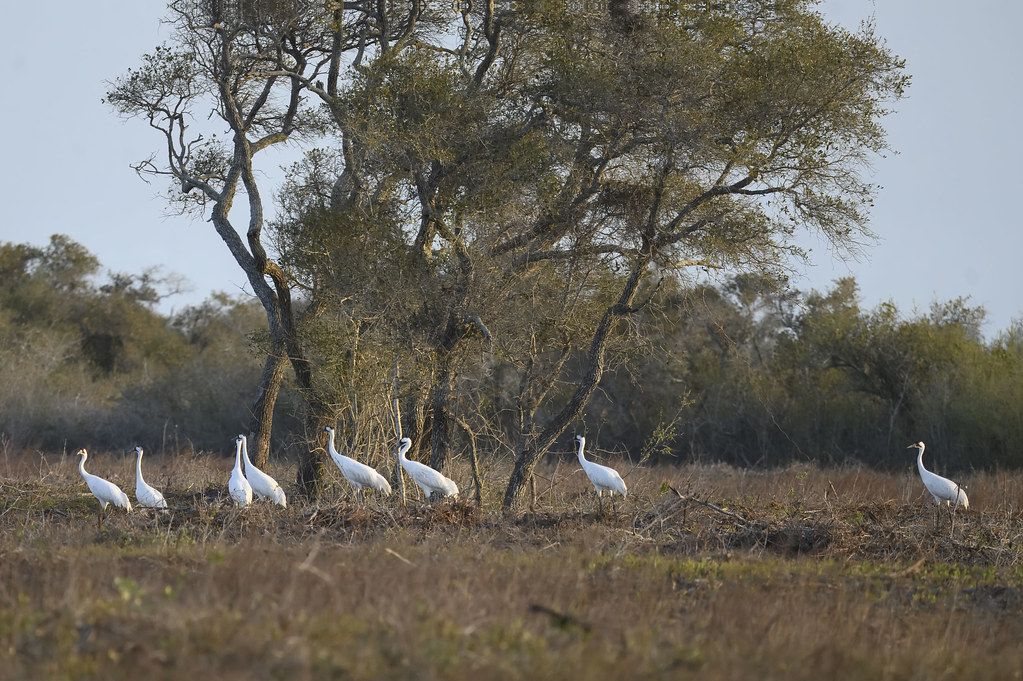
The first sight of a whooping crane tends to stop people mid-sentence. It is the tallest bird in North America, standing about as high as a person's shoulder, brilliant white with a red crown and a black streak on the face. In flight its wings show black tips, and its long legs trail behind. It moves through the marsh with a slow, deliberate walk, stabbing at crabs in the shallow water.
Every winter, the only wild flock of whooping cranes that still migrates on its own flies roughly 2,500 miles from nesting grounds in Wood Buffalo National Park, in northern Canada, to the salt marshes of Aransas National Wildlife Refuge and the bays around it. They arrive in late autumn and leave in spring. For those months, the Coastal Bend holds the birds that came closest to vanishing altogether.
A flock that nearly disappeared
In the early 1940s, the wild migratory flock had fallen to around fifteen birds. Hunting, the loss of wetlands and the draining of prairie marshes had pushed the species to the very edge. Aransas National Wildlife Refuge was established in 1937, partly to protect wintering waterfowl, and it became the cranes' winter refuge almost by chance.
Decades of protection followed: of the nesting grounds in Canada, of the wintering marshes in Texas, and of the birds along the long route between them. Numbers rose slowly, with setbacks from droughts, storms and disease. Today the flock numbers in the hundreds, still small and still vulnerable, but a long way from the brink.
The cranes return to the same general areas each year, and families often defend the same winter territories. Pairs mate for life, and young birds travel south with their parents in their first autumn, still wearing rusty brown feathers among the white.
Visiting the refuge
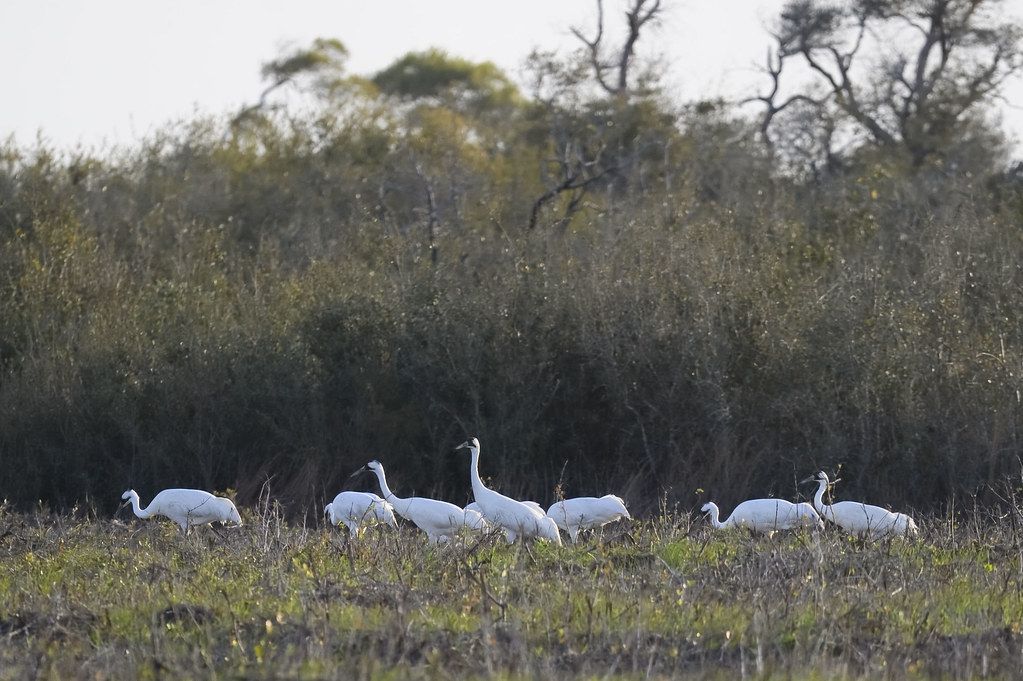
Aransas National Wildlife Refuge covers the Blackjack Peninsula, a broad stretch of oak scrub, grassland, freshwater ponds and salt marsh on the bay north of Rockport. The drive from town takes about an hour, heading north on Highway 35 and then east on farm roads through ranch country. Allow the whole morning, or more.
The refuge has a visitor centre with exhibits, maps and current sightings. From there, a paved auto loop winds through the refuge, with pullouts, short trails and overlooks along the way. An observation tower near the bay gives a wide view of the marsh, and on many winter days you can pick out white shapes in the distance with binoculars or a scope.
Entry has generally carried a fee per vehicle or person, and federal passes may apply. Bring your own food and water, because there is nothing to buy on the refuge, and fill your fuel tank before leaving the highway.
Cranes are not the only wildlife you may see. Alligators bask beside ponds on warm days, white-tailed deer graze along the road edges, and javelina sometimes trot across the loop. Wading birds, ducks, raptors and roseate spoonbills fill out the list.
Down the road · Bays and birdsGoose Island and the oak that has outlasted every stormSeeing cranes from the water
The other way to see whooping cranes is by boat. During the winter season, boat trips leave harbours in Rockport and Fulton and cruise the Intracoastal Waterway along the edge of the refuge marshes. From the water, you can often get closer to the birds than from land, and you see the marsh as the cranes do: a maze of channels, mud and low grass.
Trips usually last several hours and run in the morning. They depend on weather and on demand, and in high winds they may be cancelled. Plan well ahead in January and February, which are the busiest months.
Choose a trip run with care for the birds. Good skippers keep a respectful distance, cut their engines near feeding families and let the cranes set the pace. Expect to see other marsh birds along the way too: herons and egrets stalking the edges, ducks rafted on open water, and ospreys or other raptors perched on channel markers. The commentary on board often covers the history of the flock and the marsh as well as the birds in front of you.
Dress warmly. Even on a mild day on shore, the wind on open water can feel cold, especially early in the morning. Layers, a hat and a windproof jacket are worth packing.
How to watch them well
Whooping cranes are federally protected, and disturbing them is both harmful and illegal. Keep your distance, stay on trails and roads, and never try to approach the birds on foot. A scope or a long camera lens lets you watch without pressing in.
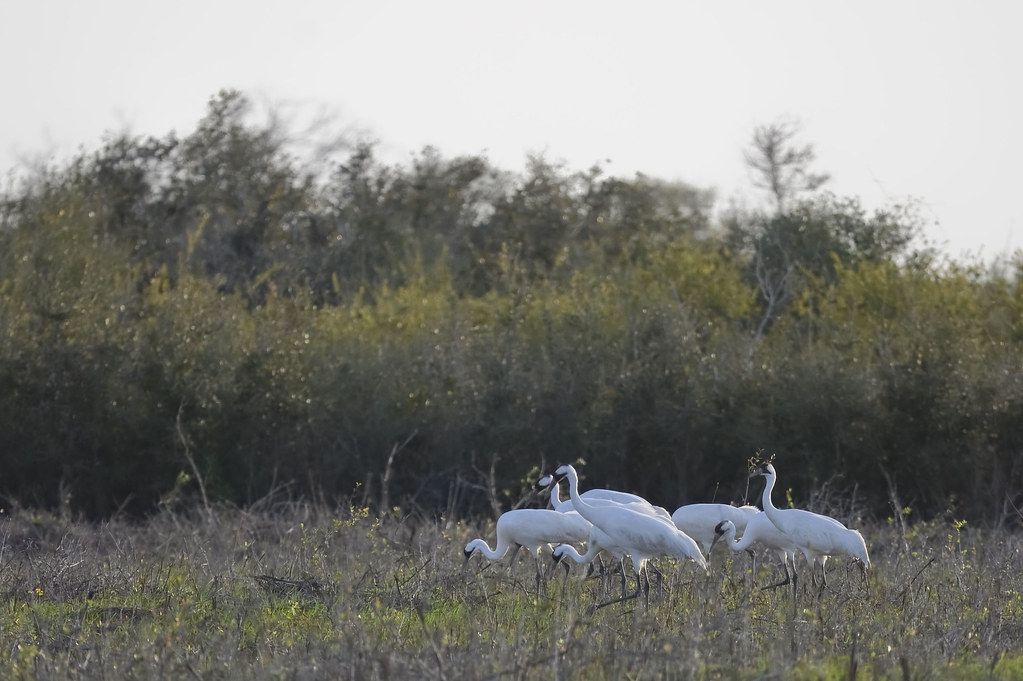
Watch for behaviour as well as plumage. Cranes feed by probing in the mud and water for blue crabs, clams and wolfberries. Pairs call together in a loud, bugling duet that carries across the marsh. Now and then, one bird will leap and flap in a short display, and the others may join in.
The best time of day is early morning or late afternoon, when the birds are active and the light is soft. Midday can be hazy and hot, even in winter, and heat shimmer makes distant birds hard to see.
Keep your distance, stay on trails and roads, and never try to approach the birds on foot.
When to go
The cranes usually begin arriving in late October and November, and most have left by early April. December to March is the most reliable window. Winter weather on the Coastal Bend is generally mild, but north winds bring sharp cold snaps, and the marsh can feel raw on a grey morning.
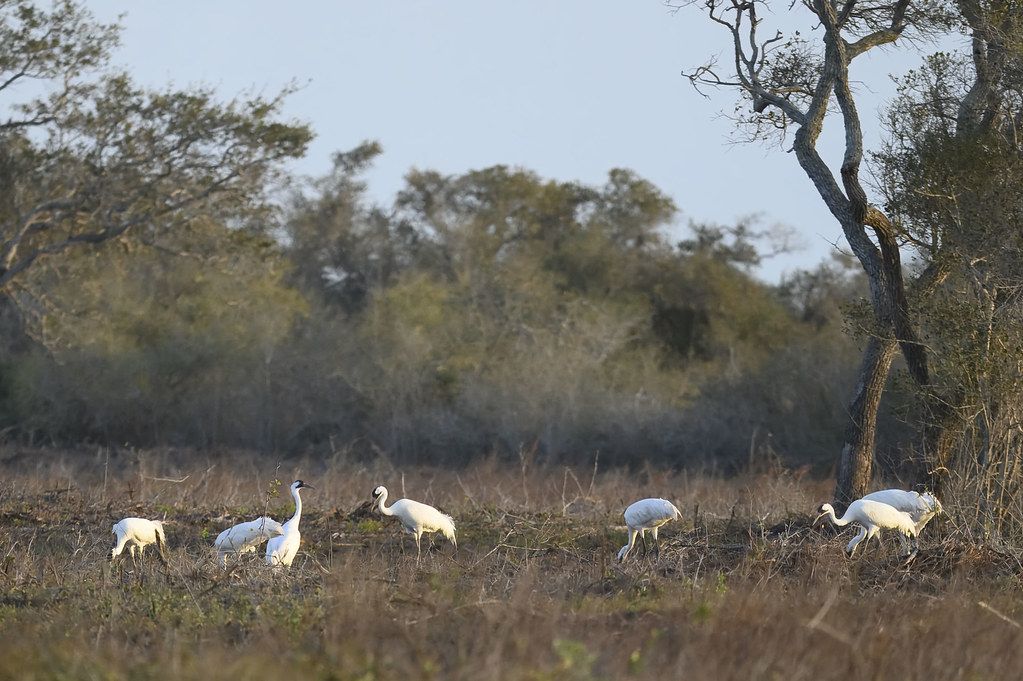
A visit to the refuge pairs well with other winter days on the Coastal Bend. Goose Island State Park, with its ancient oak, lies on the way, as described in the guide to Goose Island and the Big Tree. The Copano Bay causeway, with its pelicans and long sunsets, is close by, and the story of Copano Bay and the old causeway pier covers it. Spring brings a different spectacle, as songbirds pour across the Gulf; the guide to spring migration and the Connie Hagar sanctuaries explains the timing.
Seeing whooping cranes is not guaranteed, but on most winter days, with patience and a good pair of binoculars, the odds are in your favour. And when you do find them, tall and white against the brown grass, you will understand why so many people worked so long to keep them in the sky.
Picture credits: lwolfartist – Creative Commons BY 2.0; lwolfartist – Creative Commons BY 2.0; lwolfartist – Creative Commons BY 2.0; lwolfartist – Creative Commons BY 2.0.